

Overview information you need to know when raising Whiteleg Shrimp in 2024
Shrimp is a type of nutritious seafood, including many different types such as Whiteleg Shrimp, Redleg Shrimp, etc. Among them, Whiteleg Shrimp is a species that many people in the Southern region choose to raise because they are quite easy to raise and have high economic value. Unfortunately, most people are still confused about what Whiteleg Shrimp is and its features. The following article by Tomota will summarize the things that people need to know when raising Whiteleg Shrimp as well as to understand more about this shrimp species.
About White-leg Shrimp
Whiteleg Shrimp (species name: Litopenaeus vannamei) is a type of pandan shrimp found in the eastern Pacific region. It is commonly used as food through fishing or farming. This shrimp species is native to the eastern Pacific region, now widely farmed worldwide due to its high economic value and good adaptability to various environmental conditions.

Tôm thẻ chân trắng tên tiếng anh là Whiteleg Shrimp hoặc Pacific White Shrimp (Nguồn: Internet)
The scientific classification of Whiteleg Shrimp
To gain a better idea of where the Whiteleg Shrimp body parts in the scientific classification system, let’s look at the different levels of classification, from the broadest to the most specific:
- Kingdom: Animalia (Animals)
- Phylum: Arthropoda (Arthropods)
- Subphylum: Crustacea (Crustaceans)
- Class: Malacostraca (Higher Crustaceans)
- Order: Decapoda (Decapods)
- Suborder: Dendrobranchiata (Prawns)
- Family: Penaeidae (Shrimps)
- Genus: Litopenaeus (White Shrimps)
- Species: Litopenaeus vannamei (Boone, 1931)

Whiteleg Shrimp called with another name as Penaeus vannamei (Nguồn: Internet)
Characteristics of Whiteleg Shrimp
Whiteleg shrimp has a hard chitin shell outside the mantle. Their external configuration is divided into two main parts, which are the inlet and the ventral part.
- Cephalothorax (Head and Chest): It includes two compound eyes (also known as double eyes). On the head of the shrimp, there is a rostrum, on which there are sharp spines and two long antennae. The cephalothorax also has pairs of thoracic legs and mandibles.
- Abdomen: It has 7 body segments, of which the first 5 segments each have a pair of abdominal legs. The sixth segment does not have legs and the seventh segment is called the tail segment, combined with a pair of tail legs (or fantail).
Regarding the internal structure, the Whiteleg Shrimp has a digestive system that includes:
- Stomach: Grind the food.
- Liver pancreas: Absorbs and stores nutrients.
- Intestine: Digests the food.
- Anus: Excretes feces.

An overview structure of Whiteleg Shrimp (Source: Internet)
Distribution of Whiteleg Shrimp
Whiteleg Shrimp is a tropical species, initially found mainly in the coastal areas of the Eastern Pacific. However, nowadays, Whiteleg Shrimp has been popularized and bred in many other regions globally. Especially, countries in East Asia and Southeast Asia such as China, Thailand, Philippines, Indonesia, Malaysia, and Vietnam have succeeded in farming this shrimp species.

Whiteleg Shrimp has been imported and farmed in many countries around the world (Nguồn: Internet)
Whiteleg Shrimp’s Habitats
Whiteleg shrimp can live in saltwater, brackish water, and even freshwater environments. For optimal growth, they require a water environment with a salinity ranging from 10‰ to 25‰.
Besides salinity, other factors in the environment are important for the growth of Whiteleg shrimp:
- Temperature: 26-32°C.
- pH level: from 7,5 to 8,5.
- Dissolved Oxygen concentration: DO > 5 mg/l.
- Alkalinity: approximately 120-180 mg CaCO3/l.
- Water clarity: from 30-35 cm.
- Water hardness: from 20-150 ppm.
- Nitrite concentration (NO2-): < 5 mg/l.
- Ammonia concentration (NH3): < 0,3 mg/l, the optimal level is < 0,1 mg/l.
- Hydrogen Sulfide concentration (H2S): < 0,1 mg/l.
Maintaining appropriate water environmental factors will help Whiteleg Shrimp grow healthily, limit diseases, and enhance farming productivity.
How does Whiteleg Shrimp reproduce?
Whiteleg Shrimp is a type of sea creature. Their life cycle has 5 stages: egg, larva, post-larva, juvenile, and adult. They usually have babies from December to April, but this can change based on where they live.
Whiteleg Shrimp is an egg-laying species, and the number of eggs in each spawn depends on the size of the mother shrimp. For example, if the mother shrimp weighs from 30-45g, the number of eggs will range from 100,000 to 250,000 eggs, with an egg diameter of about 0.22mm. After laying all the eggs, the shrimp’s ovary will continue to develop. Female shrimp can lay eggs up to 10 times a year, the time between two spawns is about 2-3 days, and usually after 3-4 consecutive spawns, the shrimp will molt.
About 14-16 hours after spawning, the shrimp eggs hatch into Nauplius larvae. The Nauplius larvae go through 6 molting stages to become Zoea larvae. The Zoea larvae continue to go through 2 molting stages to develop from Zoea 1 to Zoea 3, then become Mysis larvae. The Mysis larvae also go through 3 small stages, called Mysis 1, Mysis 2, and Mysis 3, before becoming Postlarvae. At this stage, the Postlarvae have almost completed the structure of the shrimp and are ready to be released as seeds. The length of the shrimp Postlarvae ranges from 0.88mm to 3mm.
What are the benefits of farming Whiteleg Shrimp?
Farming Whiteleg Shrimp brings many significant benefits in terms of economy, health, and environment, specifically as:
Economic Factor
Raising Whiteleg Shrimp brings high economic efficiency because this shrimp species grows quickly, reaching harvest size after only 3-4 months of farming, helping farmers to harvest quickly, save costs, and bring stable profits. At the same time, Whiteleg Shrimp is one of the main seafood export commodities of Vietnam, opening up many business opportunities for shrimp farmers.

The Whiteleg Shrimp farming industry creates many jobs for workers, contributing to promoting local economic development. (Nguồn: Internet)
Nutritional Factor
Whiteleg Shrimp is a rich source of nutrition, with high levels of protein, vitamins, and minerals. They provide a large amount of vitamin B12 and contain many antioxidants, omega-3 fatty acids, and essential minerals. With a low fat content, they are a good choice for those following a diet, while the high protein content helps enhance muscle health.
Whiteleg Shrimp is also known for its omega-3 fatty acids, which have anti-inflammatory effects, strengthen the immune system, and enhance cognitive function. In addition, they are also a rich source of magnesium, phosphorus, and zinc, making up a nutritious meal for health.
Environmental Factor
Whiteleg Shrimp can thrive in various environments such as mud, brackish water, freshwater, and salt water, allowing shrimp farmers to choose a farming method that suits their specific conditions.
Growing Whiteleg Shrimp is good for the environment. They clean the water by removing harmful stuff. They also eat algae and other things, which lowers the amount of nitrogen and phosphorus. This helps keep the water clean and makes a healthy place for other animals to live.
The secret to raising Whiteleg Shrimp is to apply technological solutions
Growing Whiteleg Shrimp can be quite complex, so Tomota will introduce advanced technological solutions to increase the success rate and reduce the risks of shrimp farming right below.
The solution S3N for counting Nauplius
Understanding the difficulties of farmers in counting the number of Nauplii at the hatchery, Tomota S3N offers a technological solution specialized in counting the number of Nauplii by applying AI technology to optimize efficiency, making the work faster and more convenient. With just 6 seconds of filming, technicians at the hatchery can determine the number of Nauplius up to 6,000 individuals with an accuracy of over 95%.
Furthermore, accurate analytical data helps farmers make correct assessments of the quality of parent shrimp and the survival rate of Nauplii. This allows for the optimization of production plans, ensuring a sufficient supply for the market.
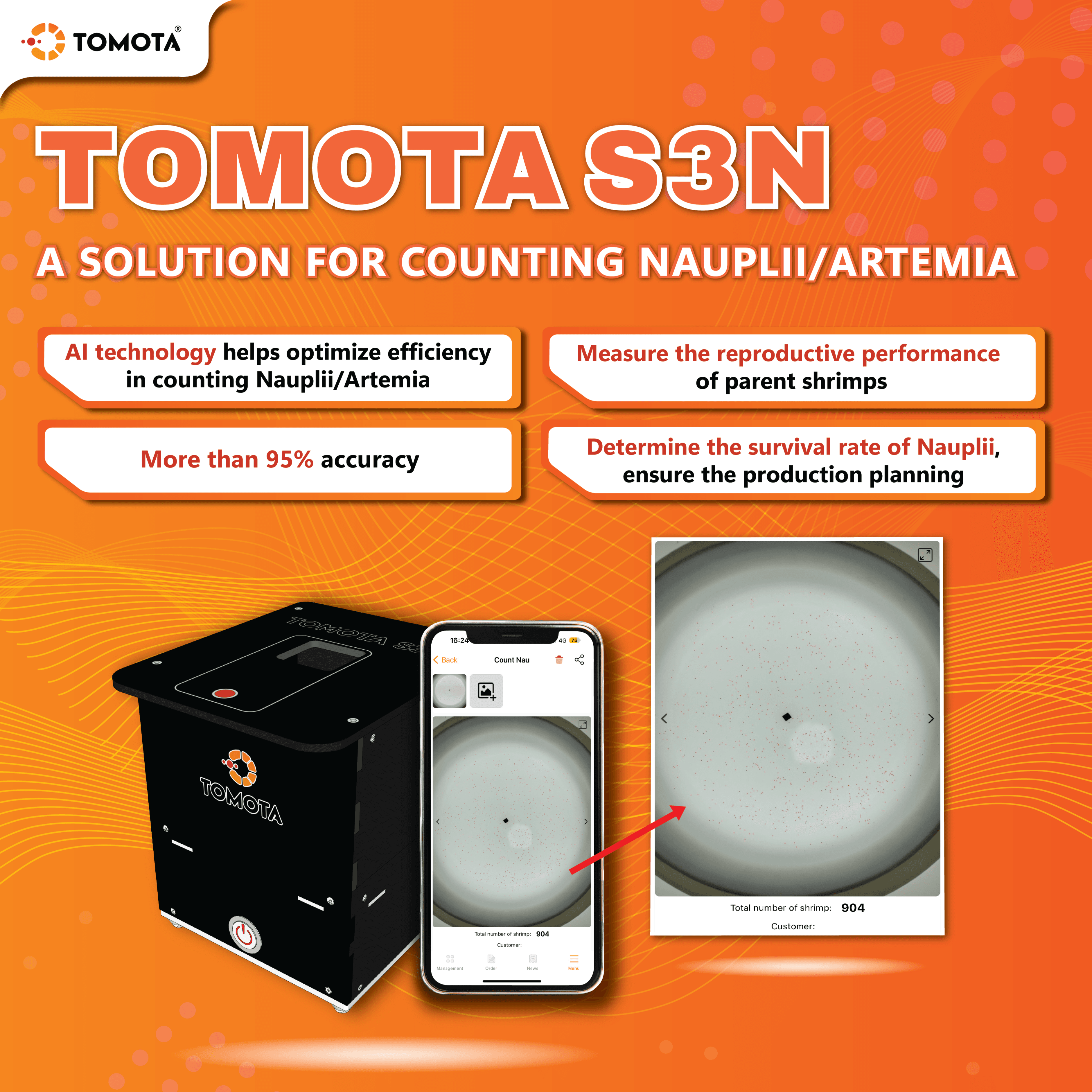
The outstanding feature of Tomota S3N helps hatchery owners forecast the output of shrimp larvae and create effective plans to optimize the production of larvae. (Source: Tomota)
The solution to monitor the growth rate of shrimp Tomota S3
Manual shrimp counting will become easier and more time-saving with Tomota S3. This solution integrates 2 features in 1, both capable of counting the number of shrimp post-larvae, and measuring the size and monitoring the growth rate of large shrimp, applicable to both hatcheries and farms.
For hatcheries, Tomota S3 can accurately count up to 95% of the number of shrimp post-larvae up to 4000 individuals in just 10 seconds. This not only helps enhance the process of packing and exporting shrimp post-larvae at hatcheries more quickly and conveniently but also ensures the supply of quality post-larvae for customers, contributing to building and enhancing the reputation of the hatchery.
For farms, Tomota S3 makes the daily and weekly shrimp measurement process more convenient and efficient for farmers. The size, length, weight, and growth rate of shrimp can be quickly measured through the Tomota application on the phone. Based on data such as growth charts, size measurement logs, and revenue estimates, shrimp farmers can easily make timely decisions and choose a reasonable harvest time to maximize profits and optimize costs. All data is also stored and can be easily extracted.

Tomota S3 - technological solution supports farmers in shrimp post-larvae and measures shrimp size (Source: Tomota)
Frequently Asked Questions (FAQ)
How much capital is needed to farm Whiteleg Shrimp?
The capital depends on farming's scale and method. Generally, the cost to farm 1kg of shrimp will fluctuate around 85,000 VND.
How long does it take to farm Whiteleg Shrimp to harvest?
The time of farming Whiteleg Shrimp depends on various factors, however, it usually takes about 3-5 months.
What is the current market for Whiteleg Shrimp consumption?
Whiteleg Shrimp is a key export commodity, with a very open market.
Farming Whiteleg Shrimp is a potential industry with many economic, health, and environmental benefits. To achieve success in this field, farmers need to equip themselves with professional knowledge, apply advanced farming techniques, and manage shrimp ponds effectively. Hopefully, this article from Tomota will help farmers gain more knowledge and experience to successfully farm Whiteleg Shrimp.